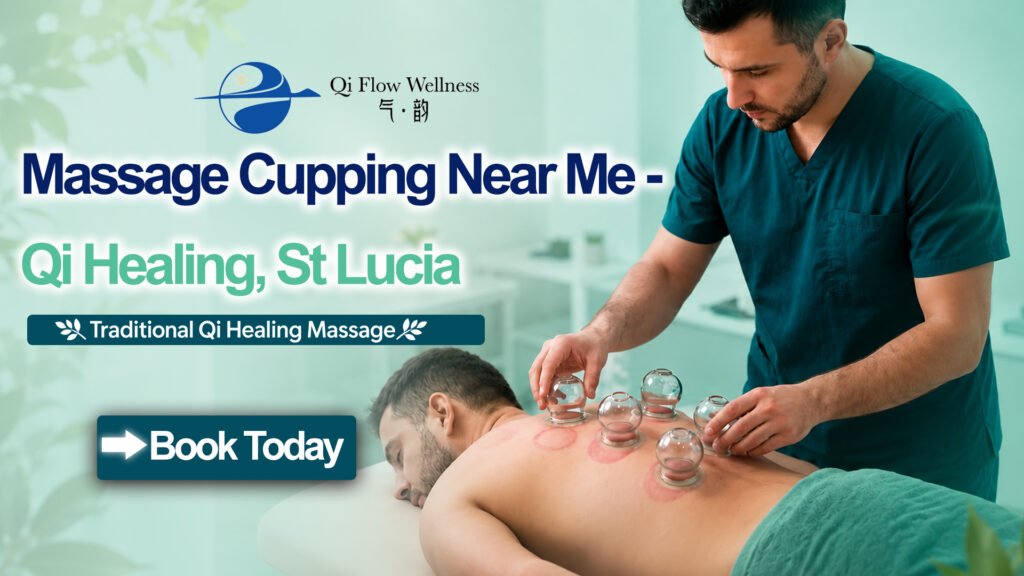
Most people searching “massage cupping near me” are chasing relief for a tight shoulder or aching back – fair enough, cupping is genuinely good at that. But there’s a deeper layer most Western explanations skip entirely: cupping isn’t just pulling on muscle, it’s addressing something Traditional Chinese Medicine calls Qi stagnation – a blockage in the body’s energy flow that shows up as physical tension long before you notice it consciously.
At Qi Flow Wellness in St Lucia, cupping is practiced as genuine qi healing massage – rooted in classical TCM theory, not a wellness-trend version of it.
What Is Qi, and Why Does It Matter for Cupping?
In TCM, Qi is your body’s vital energy, flowing through pathways called meridians to nourish your organs, muscles, and tissues. When Qi flows smoothly, the body functions and heals as it should. When it’s blocked or stagnant – often from stress, poor posture, cold exposure, or overuse – that blockage tends to show up physically as muscle tightness, pain, or restricted movement in the very areas cupping is used to treat.
This is the real explanation behind why cupping works where it works: the suction doesn’t just release physical tension, it draws blood and Qi back into an area where flow has stalled.
How Qi Healing Massage Differs From Standard Massage Cupping
A lot of clinics apply cupping mechanically – cup on, cup off, move to the next spot. Genuine qi healing massage starts with understanding why Qi is stagnant in a particular area for you specifically, often assessed through pulse and tongue reading, before cups are placed with intention rather than routine.
If you’re more interested in the muscle-mechanics side of cupping and how it pairs with remedial massage session-to-session, we’ve covered that in more practical detail in our massage cupping near me guide. This piece is about the deeper TCM principle behind the technique.
Signs of Qi Stagnation Cupping Can Help With
- Chronic muscle tightness that doesn’t resolve with regular massage alone
- A sense of physical “heaviness” or sluggishness in specific areas
- Tension that flares up with stress or emotional strain
- Cold-sensitive stiffness, especially in shoulders and lower back
- Recurring tightness in the same spots despite treatment
Qi stagnation is also closely tied to broader wellbeing – our page on cupping therapy Brisbane explains how cupping fits into a wider natural pain-management approach, while moxibustion (covered in our TCM Wellness overview) is often used alongside cupping for cold-type stagnation specifically.
How Cupping Is Combined With Other Qi-Restoring Treatments
Cupping rarely works in total isolation within TCM. It’s commonly paired with:
- Acupuncture – to directly stimulate meridian points and restore Qi flow at its source, detailed in our acupuncture Brisbane guide
- Moxibustion – warming therapy that strengthens Yang energy, particularly useful for cold-pattern stagnation
- Remedial massage (Tui Na) – hands-on meridian work that complements cupping’s suction-based release
Our piece on how TCM and remedial massage work together for injury recovery covers how these modalities layer together in a real treatment plan.
What to Expect During a Qi Healing Cupping Session
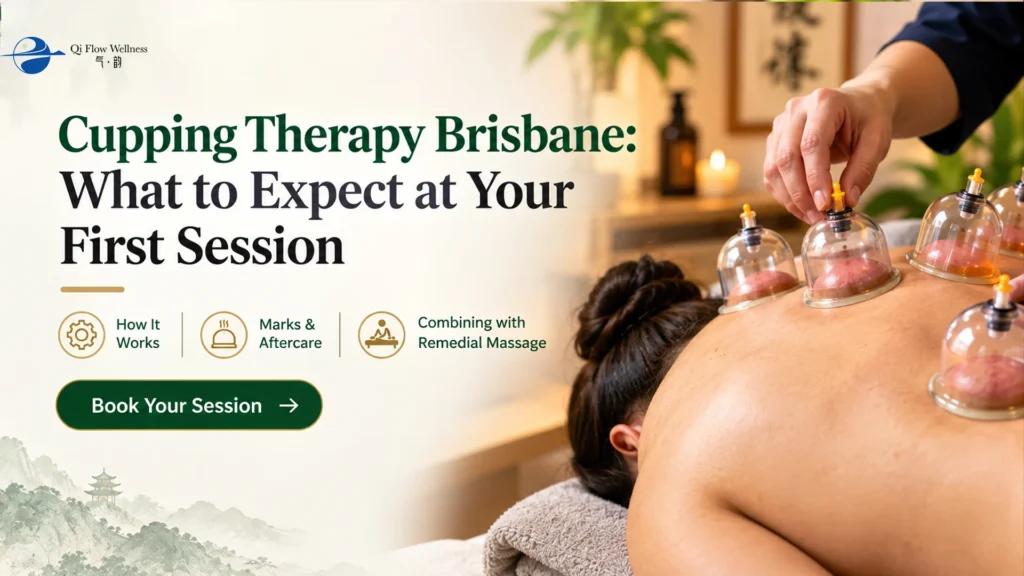
Your practitioner begins with a proper TCM consultation – not just “where does it hurt,” but questions about your sleep, stress levels, and overall constitution, since Qi stagnation is rarely isolated to one muscle. From there, cups are placed with intention on the areas assessed as blocked, sometimes combined with gentle gliding technique to encourage flow along the meridian rather than a single static point.
It’s completely normal to leave with circular marks – a visible sign that stagnant blood and Qi have been drawn to the surface, not a bruise in the injury sense. These typically fade within a few days.
Meet the Practitioners
- Dr. Juan Xiao – Registered Chinese Medicine Practitioner and Acupuncturist with 10+ years of clinical experience, China-trained, understanding cupping and Qi theory as part of a complete diagnostic system rather than an isolated technique.
- Dr. Hannah Chen – AHPRA-registered with the Chinese Medicine Board of Australia, grounding every treatment in classical TCM theory, including how Qi stagnation presents differently from patient to patient.
Both practitioners continue studying with senior TCM doctors to keep their approach aligned with classical theory and modern clinical standards. Read more about the full team on our Our Therapists page, or our clinic philosophy on Qi and long-term balance.
Why St Lucia Locals Choose Qi Flow Wellness
Based at 218 Hawken Drive, St Lucia, we’re accessible from Indooroopilly, Toowong, and the wider Brisbane inner-west – see our guide for acupuncture near Indooroopilly and Toowong for more on the local area. With a 5.0 rating from 20+ Google reviews, most new patients arrive through genuine word of mouth. Read real feedback on our reviews page.
Session Details, Pricing & Health Fund Cover
- Session length: Qi healing cupping is typically incorporated into a 45–90 minute session alongside massage or acupuncture
- Health fund cover: Most major Australian health funds cover cupping when bundled into a remedial massage or TCM claim – check your specific policy
- New patients: Complete your intake forms in advance to speed up your first visit
- Booking flexibility: Same-day appointments are often available
Ready to Address What’s Really Blocking Your Flow?
If tension keeps returning to the same spots no matter how much you stretch or self-massage, the root cause might be Qi stagnation rather than the muscle itself. Book an appointment with our team in St Lucia, and we’ll help you understand what your body’s actually telling you.
Frequently Asked Questions
1. What does “qi healing massage” actually mean?
It refers to massage techniques, including cupping, used specifically to clear blockages in the body’s Qi (vital energy) flow along its meridian pathways, rather than working on muscle tissue alone.
2. What is Qi stagnation?
Qi stagnation is a TCM concept describing blocked or restricted energy flow in the body, often caused by stress, poor posture, cold exposure, or overuse, and commonly presenting as muscle tightness or pain.
3. How is qi healing cupping different from regular massage cupping?
Qi healing cupping is guided by a TCM assessment of where and why energy flow is blocked for you specifically, rather than being applied as a standard, generic routine to sore areas.
4. Can cupping alone clear Qi stagnation?
Cupping helps, but it’s often combined with acupuncture, moxibustion, or Tui Na massage for a more complete restoration of Qi flow, depending on what your practitioner assesses.
5. Why do I keep getting tension in the same spots despite regular massage?
Recurring tightness in the same areas can be a sign of underlying Qi stagnation rather than a purely muscular issue, which is why a TCM-based assessment can sometimes succeed where standard massage alone hasn’t.
6. Does qi healing massage have scientific backing?
Qi and meridian theory come from classical TCM rather than Western biomedical models, though the physical effects of cupping – improved circulation and tension release – are increasingly studied and recognised in clinical settings.
7. Is qi healing cupping covered by health insurance?
When bundled into a remedial massage or TCM session, cupping is often covered under extras cover with major Australian health funds. Check your specific policy for details.
8. How long does a qi healing cupping session take?
It’s typically incorporated into a 45–90 minute appointment alongside massage or acupuncture, with the cupping portion itself usually taking 10–20 minutes.
9. Is qi healing massage suitable for stress and emotional tension, not just physical pain?
Yes – in TCM, emotional stress is understood as a common cause of Qi stagnation, so treatment often addresses both physical tightness and the stress contributing to it.
10. Do I need an acupuncture session as well, or can cupping alone help?
It depends on your individual pattern of stagnation. Your practitioner will assess this at your first visit and recommend whether cupping alone or a combined approach is right for you.